mardi 11 octobre 2011

Rapport 2011: l'essouflement des musées


La révolution de la création du ministère de la Culture de 1959 se trouve bien loin de la situation actuelle. Avec le tout premier ministre de la culture, "l'irrationnel" André Malraux, la France, bien que tardive comparée aux états Unis et aux autres pays de l'union européenne, touche enfin du doigt la chance de naître sur le plan de la gestion culturelle. Se trouvant à la tête d'une nouvelle institution au cœur du ministère intérieur, Malraux fait poindre une politique culturelle révolutionnaire et novatrice, mettant enfin à disposition du public les outils juridiques nécessaires à de vraies propositions à l'égard de la conservation, l'analyse et la présentation des collections françaises. Matérielles ou immatérielles, les ressources d'œuvres d'art dont regorgeaient les réserves des musées nationaux furent mis à jour sous l'interventionnisme du ministre assoiffé de culture, bien que critiqué et ralentit par le tournant de 1968.
Le temps est au rêve éveillé.

A l'heure actuelle, le ministre de la culture n'a pas le temps de déclarer comme son ancêtre, qu'il est " entré dans l'art comme on entre en religion ". Les préoccupations se placent sur un tout autre plan. La sonnette d'alarme est tirée, et le monde de la culture française, notamment celui concernant les musées nationaux, décompte sa chute, lente mais vertigineuse.
Avec la publication du Livre blanc sur les l'état des musées de France le 4 février dernier par l'Association générale des conservateurs des collections publiques de France, le corps de métier des musées, jusque là particulièrement discret, s'exprime sur la mise en péril de leurs institutions.
Le rapport des conservateurs regorge de critiques et de constat sur l'état des musées de France, qui construisaient jadis l'identité nationale. Le problème se pose évidemment à la base du fonctionnement du Ministère de la Culture et surtout à ce que l'État lui accorde.
On ne peut qu'aborder la rupture quantitative de l'arrivée de Jack Lang au ministère avec nostalgie, ne datant pas plus de trente ans. Et pourtant, les moyens budgétaires n'y sont plus reconnaissables quand la Culture disposait à cette époque de six millions de francs disponibles à son développement. Aujourd'hui, Frédéric Mitterrand, dont le service fût profondément affaiblît suite au ré-aménagement du ministère, ne dispose pas plus que moins d'1% du budget de l'état pour gérer tous les services culturels du pays. Avec un budget se contenant dans de telles conditions, autant dire que les conservateurs ne font que ramasser les miettes. Ce n'est donc pas une surprise s'ils se font entendre aujourd'hui, et l'état risque de bien les entendre. Les solutions ne tombent pourtant pas sous l'évidence.
Le premier point du Livre blanc, que l'on pourrait appeler plus judicieusement livre noir, s'adresse au statut changeant des musées, dirigés aujourd'hui selon une logique ultralibérale, bien loin de ses origines. Le service de base public, face à ces restrictions budgétaires massives, se voit transformé en véritable entreprise lucrative. "Nous sommes confrontés aux mêmes problèmes que les hôpitaux et universités", commente Christophe Vital, président de l'association. En effet, la situation est telle que certains musées se voient obligés de s'autofinancer, ce qui semble pourtant impossible. Qu'est-il donc arrivé au statut originaire d'institution publique à caractère administratif, ne devant à la base gérer ses services qu'à l'aide de l'état et d'un système de mécénat? Il n'en est plus, ou presque plus.
Le rapport est tel qu'il en expose les conséquences: certains musées ne possèdent même plus de système de climatisation suffisant à la bonne conservation des peintures, celui des Augustins de Toulouse a même du fermer pendant l'été 2009, ne se trouvant plus dans la possibilité d'ouvrir ses collections au public. Beaucoup d'institutions rapportent que leurs réserves se trouvent en état de péril, y compris dans de grands musées parisiens, où les œuvres fragiles s'entassent, les équipes muséales assistant impuissamment au spectacle.
Le seul moyen de survie devient alors l'organisation intempestive d'un grand nombre d'expositions temporaires hors budget attirant le grand public. C'est ainsi que depuis plusieurs années se dresse un défilé d'évènements tels que Manet, Courbet, Giacometti, Munch,Koons... un événementiel à gros chiffres qui délaisse malheureusement des projets d'expositions inédits et refusés d'entrée par peur d'un manque de visiteur.
L'heure est à la préoccupation d'évènements "rentables" tandis que le pourcentage du mécénat pointe dangereusement vers le bas. Les mécènes se détournent alors des grands musées n'y trouvant plus leur intérêt.


Autant dire que la France est rentrée dans un cercle vicieux dont il sera très difficile de ressortir.
Peu à peu ces nouveaux musées-entreprises affirment leur différence, et ceux qui peuvent se permettre l'organisation de ces expositions évènements de grande masse n'hésitent plus à le faire, laissant ainsi les plus petits musées sur le banc de touche, évidemment souvent de provinces. Un écart saillant est donc en train de se former entre petits et grands musées. Les derniers, conscient qu'ils peuvent posséder un chef d'œuvre de marchandise, n'hésitent également pas à passer outre la déontologie des musées dont la logique qui en découle serait le prêt des œuvres entre institutions. C'est ainsi que Le Louvre vend sa marque en louant certaines de ses œuvres à Atlanta ou Abou Dhabi. Le musée phare national français en vient donc à se détourner de la circulaire du ministère de la culture de 2007 stipulant que les collections ne se monnayent pas, elles ne peuvent être assimilées à une marchandise, un prêt ne peut être assimilé à une location.
A titre de résultat, les musées de provinces, n'ayant rien ou peu à monnayer et ne recevant rien ou peu en prêt de la part des autres institutions, se voient dans l'impossibiliter d'organiser ce genre d'exposition à public et donc se retrouvent dans un état de pauvreté franchement alarmant. En résumé, le constat est là: sur les 1 214 musées de France, un sur deux réalise moins de 10 000 entrées par an, alors que le Louvre en reçoit près de 10 millions.

Enfin, le rapport non moins salé du petit livre noir sur l'état des musées se referme, dressant une facture lourde non seulement pour les institutions mais aussi pour le personnel dirigeant. C'est ainsi qu'en même temps que le musée se trouve en danger, le poste de conservateur également se trouve sur un terrain glissant. Avec un effectif baissant de 20 à 30% en dix ans, le pion qui fut auparavant la pièce clé de l'échiquier se retrouve en compétitions, si ce n'est en position claire d'infériorité avec de vrais chefs d'entreprises, gestionnaires ou énarques. Les formations telles que HEC vont pouvoir remplir leurs effectifs,le statut de conservateur de musée changeant considérablement, le conservateur historien passionné d'art se retrouve relayé au fond pour ne plus être considéré à sa valeur originelle. Les amateurs d'art en tout genre vont devoir s'armer de courage quand on sait que les futurs programmes d'expositions seront peut être organisées un jour par un économiste ou financier dont le seul but sera de compter les entrées et dont le but didactique, scientifique et de délectation du musée lui semble complètement inconnues et absurdes.
Cependant, l'heure est aussi à l'autocritique, ce que Vital assume et en prend la responsabilité, afin d'éviter une certaine disparition progressive l'heure est aussi à la remise en question du côté des conservateurs, afin de parvenir à de véritables solutions et interventions étatiques efficaces.

samedi 30 juillet 2011

Hommage de chair, Lucian Freud


L'Histoire de l'Art ne s'arrête pas à une succession de toiles à analyser, c'est aussi et surtout une question d'émotions, de sensations. Une idée qui se trouvait à l'épicentre de la carrière de Lucian Freud, l'un des derniers peintres hyperréalistes contemporains. Le petit fils du psychanaliste Sigmund Freud né à Berlin le 8 décembre 1922 obtenu la nationalité Britannique lorsque sa famille du fuir le nazisme allemand. Dès le début de sa carrière sa longue série d'autoportrait l'amena à rencontrer Francis Bacon avec qui il se lia d'une grande amitié et d'échanges artistiques majeurs. Tous deux furent alors caractérisés par l'étiquette d'Ecole de Londres, naturellement mise en opposition avec l'école Parisienne contemporaine. Parmi ses figures d'inspiration, aux côtés de Bacon, trôna Alberto Gicaometti dont la représentation du corps le guidera plus tard vers une nouvelle interprétation de la chair quelque peu inédite.
Petit à petit, le peintre allemand multiplie les peintures d'atelier, les intérieurs habités d'objets du quotidien, les vues urbaines et impressions végétales.
Arrivé aux années cinquante, Lucian Freud laisse de côté les traits lisses anguleux aux penchants parfois surréalistes qu'il réfute entièrement, pour adopter une technique changeante, partant du centre du chassis pour aller jusqu'aux périphéries, laissant tomber toute idée de dessin préparatoire.
Suite au passage à la 27° biennale de Venise où il y présente le fameux énigmatique portrait de Bacon, Freud troque ses pinceaux fins pour des brosses en poils de porc lui permettant l'empatement surexppressif dont sa peinture en est la principale caractéristique.

Freud construit peu à peu son style arborant une expression violente, mise à nue. Le peintre adopté britannique joue ainsi avec les points de vue inhabituels en parallèle avec des poses inattendues de ses modèles de chair nue. Malmenant le modèle classique du nu, Freud dépeint une chair crue, débordante et dégoulinant sur les tissus abîmés des fauteuils poussiéreux de son atelier. Freud veut peindre une vérité teintée d'érotisme et de grande poésie. Depuis des siècles pourtant, nous savons bien qu'académie est synonyme de nu. Pour Freud, il ne s'agit manifestement pas du même "faux" nu. La chair du peintre est accidentée heurtée et détendue à la fois, au coeur d'un cadrage la plaçant aux antipodes des conventions. Les tissus se déposent, à travers les grands coups de pinceaux verticaux, sur un cadre parfois même inachevé, fenêtres ouvertes sur la vérité d'un corps souvent ingrat.
Le peintre expose une vérité moderne comme si sa mission était de nous représenter la vision de l'enfant dont parle Beaudelaire dans Le peintre de la vie moderne:
Il assistait à la toilette de son père et contemplait avec une stupeur mêlée de délices, les muscles des bras, les dégradations de couleur de la peau, nuancée de rose et de jaune, et le réseau bleuâtre des veines.

C'est ce que le spectateur découvre avec stupeur et fascination face aux toiles de Lucian Freud, ressentant un certain malaise devant une vérité transcendante. Chez Freud, et pas seulement à cause de son grand père, une dimension psychanalitique se fait ressentir autant dans ses nus que dans ses autoportraits, inédits par le point de vue et la place du miroir, une provocation à la fois cachée et déballée devant nos yeux ébahits. Car même si la frontalité des chairs s'expose sans retenue, la dimension psychique des modèles semble aller bien plus loin. C'est pourquoi Freud n'est pas tout à fait un peintre réaliste. Nous nous trouvons bien loin d'une représentation minitieuse et microscopique, nous touchons plutôt une illusion de la vraisemblance à travers la densité d'une présence.
Essuyant plusieurs rétrospectives de son vivant, Lucian Freud acquit trés rapidement une notoriété internationale florissante, ses toiles ont remodelé l'art britannique. Décédé ce mercredi 20 Juillet dernier, le monde de l'art contemporain perd avec lui un grand poète.

samedi 21 mai 2011

Recall: Video Art


When the French symbolist poet rewrote the words of Cervantes “history, the mother of truth” he suggested the famous quote as a meaning of a certain multiplicity of truths to a composite present. Adam Chodzko takes a similar approach with his work when social situations and stories are conducting to their own gestation of narration. Something which might not be immediately evident and visible but reached by a complex and wide range of evidences of anthropology.
Born in 1965, Adam Chodzko is an artist living and working in London, in his work he explores the interactions of human behaviour through several domains from posters to photograph and video installations. Among the large amount of his video works, he poses the question of how can we engage with the existence of the others, exploring both community and private spaces, documents and fictions, and choosing to work directly with places and people surrounding him.
Graduated in history of art in the University of Manchester and then at the Goldsmiths college between 1992 and 1994, he intensively exhibited, since 1991, in international solo and group exhibitions.
Chodzko's work is thus often an introduction or a request on the public space and one of these signals are seen in the Secretors, lead crystals of manifestation juice approximatively of 60 cm long each. And one of his first manifestation in video was the insertion of one Secretor placed behind the Shadow chancellor of the Exchequer Gordon Brown in an interview broadcasted on ITV news at ten the 27th July of 1994. These Secretors come from a sort of kit where Chodzko put them everywhere, perceived in the corner of your eye falling into a space like tears. The title of thousands KM/HR meant to be the speed they travel at, creating falling energies, Chodzko is here trying to work with a surreal that leaks out of the everyday reality by inserting fictional feature in an ordinary situation

History and the past takes a great signification in the work of Adam Chodzko, when he gave a voice to the actors of Russel's movie The Devils and Pasolini's Salo or the 120 days of Sodome in respectively the works From Beyond and Reunion: Salo. By recalling them and giving them a second voice, Chodzko recreates and disrupts at the meantime the films, he make us realise that it takes a place in the individual life, one significant fictional event in their own experience.
Salo, or the 120 Days of Sodom, was the last film by Pier Paolo Pasolini, one of the most famous Italian director murdered in 1975. Salo is a violent film at times unbearable but sorrowfully poetic about Fascism, it's no longer widely shown but those who saw it cannot forget it. The movie evidently made a strong impression on Adam Chodzko when he made the work Reunion: Salo. He tried by placing ads in the newspapers, to reunite the sixteen people who, in Pasolini's movie played the role of sixteenth adolescents tortured to death, using again communication as a tool for creating the work of art. After three months of research the only person who had reappeared in the present was the only one who didn't died in the movie as she asked to the director who had respected her wishes. Thus, Chodzko had just one actress who already had eluded her fictional death, he clearly had to change his project when all the others, maybe traumatized by the extreme sadism they'd staged, didn't respond to the reunion. He then replace real actors by boys and girls doubles who resembled them as closely as possible. Thus at the end, the piece resulted to documentation of the project comprising explanatory texts, photographs of the doubles and a video capturing the encounter between them and the original actress covered by a voice over of Chodzko explaining the construction of the work.
So here even if the really work didn't resulted as it had to be in the original idea of the artist, Chodzko is creating once again a recall to the past through communication which has been slightly revelating when the reaction of the actors tell us that they didn't forget and they were kind of eternally traumatized by what they did in the past equally as the spectators were. We also can see the gap between reality and fiction, when the only real actress whose part of the work didn't act her fictional death. Thus Chodzko tell us a story which seems to be true in first instance but then reveals its falseness with fake actors which look like they're eternally young since the movie.
The same year, Chodzko created a similar reunion with Nightvision a thirteen minutes long video projection on two screens. The work presents a selection of technicians from rock concert, rave and theatre lighting companies who were asked how they would light heaven. On the first screen we can see a woodland groove filmed with a night-scope lighted by the group of the technicians covered by the soundtrack of their talking about lighting heaven. The superposition of these barely visible people working to light a wood and the poetic speculations of their vision of light heaven creates a strange atmosphere connecting again the reality in terms of specific and technical language and the imagination of these people. When we hear at the end a loud electrical charge of a heavy switch being thrown, the projection crosses the room and goes on the second screen of the opposite wall. Thus the viewers turn and the realisation of the technicians is at least revelated in brilliant blue, orange, gold and green lights. Here perhaps, is a visual formulation of the biblical pronouncement Let there be light. Here we can see that there is a religious dimension in Chodzko's work when he reveals existential questions through the human reflex of constantly wondering “what if...?” when sometimes, art could respond to it by clarifying our relationship to reality and create a non-space known by everyone.
A place for the End, is also dealing with some kind of end space. It presents a DVD with sound installation of ten minutes showing places that seems almost inhabited or habited by a couple of figures mostly showing them turning back to the camera or in darkness. Chodzko is clearly preoccupied with end spaces, considering it like gap places between fiction an reality.
The project of this work consist of group of strangers asked by the artist to choose a location where they thought a film might end, they all picked kind of non-spaces around the city, emotionally charged and quite dramatic looking. After that, Chodzko placed a plaque in each location stating them as a place for the end of a film without describing what really happened here because it was not really places where something happened but where something only might happened.
It is obvious that the central key in Chodzko's pieces is people. These people, strangers who were asked to reunite, are certainly not stereotypes or archetypes but much more individuals marginalised choose for their relationship with something special or someone else like the mother in Producing Siblings or the big guy himself in the God look-alike contest. They are all caught to reconstruct their identities significant of inner truth in the human experience of living through fiction and reality.
With the work Involva of 1995, Chodzko explored more deeply people's reaction after posting a pencil drawing of a forest above the inscription “Please will you join me?” in the pages of the sex contact magazine Experience. Submerged by responses and requests about the mystery place, Chodzko then photographed the letters in a forest resembling to the one of the drawing. He is thus confronting the place in the drawing which could be both an actual place or a state of mind, real and fictional, with real letters mixed to a real place which could respond to the imagination of their authors. We can see here that all his interest is to break down the systems of communication to analyse them more closely.
There is often a return to the past in Chodzko's work through video. In that sense he used again communication to construct his new work Recall: Strange child in 1997 by putting an ad in the newspapers which text was: Recall, where you a strange child? All people who were strange children are invited to make a beautiful place for ourselves. He thus made a reunion in which participants, now adults, described their peculiarity into the narration of a film, all the strange children were now unified into a familial group of temperaments. In this way he use to play sort of God creating new circumstances which will reveal questions about past and existence.
In several works, Chodzko wanted to create reunions and meetings of strangers using the strategy of placing and advertisement in the free ads newspapers. Among the very first ones were the works International god look-alike contest, From beyond and Reunion: Salo. With the international God look-alike contest contains an assemblage of pictures sent to the artist as he asked through an advertisement, of people who think they look like God. But he also created an idea of a reunion which never happened in the work Meeting. The work comprises a series of fifteen A2 drawings following the poster of a format. The poster announces “Meeting of people with stammers to describe a fire. Here. Everyone welcome.”, associated with a precise drawing of a fire mixed up with curve lines and arrows as it conducts the viewer to read the drawing. The statement of the poster seems clearly simple at first instance, there is a meeting and here is a picture of a fire for you to describe and discuss, but nearer, it appears much more intangible when it is addressed to stammerers. The drawing hits the eyes of the viewer and, the fact that it is involved in a seriality, make the work only on possibility among a large amount of others. Thus Meeting is not a realisation of a meeting, but a reason that might be for people to reunite and a probable result for what might happen.
In Loose Disclaimer created in 2000, Chodzko enters more precisely in the word of films and their ends. It presents a series of six one minute videos showing a film's disclaimer being illuminated by a marine distress flare around the periphery of a city at night, another marginal space. The disclaimer texts: “The characters and incidents portrayed and the names herein are fictitious and any similarity to the name, character and history of any person, living or dead, is entirely coincidental and unintentional.”
While the flame is burning the girl who performs explains in voice-over the difference between the fact that she experiences it and watches it.
Then Chodzko's added these six minutes videos at the end of six video tapes he rented from video shops, highlighting the fact that what you just watched was only a film, forcing the audience to realise that it was only a fiction while the performance girl is claiming that her experience of being in the video was surely better than what you just watched. Chodzko here is asking again the relationship between reality and fiction and makes us ask ourselves which one would be better or worse between watching a fiction, something often close to reality or living in a reality highlighting a fictional aspect of it.
Limbo and land, a 10 minutes and 40 seconds video (DVD) made in 2001, could be seen as different from Chodzko's previous works in video. It contains shots showing empty deserted landscapes and abandoned clothes cut with scenes of two people attending the beside of a third unseen character, confronting empty and emotionally scenes together. The camera makes some moves that place it as the viewer in the middle of the emotional scenes looking straight into the eyes of the actors. At other times, the camera moves through the landscape in a way that would be impossible for a human being. A women voice is covering these images, trying to understand the meaning of the work, letting the debate opened. We thus hear this woman trying to respond to a work which, as most of Chodzko's works, has been left with a meaning and purpose unclear. When it should be seen has a default to the work we thus understand that the process of the video is clearly trying to represent an event not totally comprehensible, something depicting certain situations or states of mind that cannot be filmed or expressed, never mind which domain we choose to depict it or constructing a coherent aesthetic.
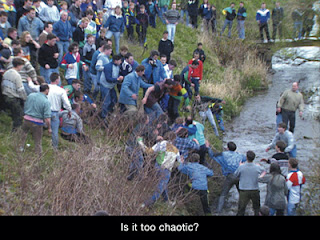
Plan for a spell is a DVD created in the same year that Limbo Land, it is constructed by several images of social spaces from the contemporary British landscape filmed (a demolition derby for instance) , some shots concerned with movements and coincidences (like a weaver's hands or the blades of win turbines). The DVD is encoded to randomly assemble the sound, vision and subtitles so every time it is played it will play in a different order creating each time a new spell for the sequence. Chodzko here is playing with the notion of narration when it is infinitely evolving in a new scheme impossible to predict. His fascination with how our imagination and beliefs operate comes to mix itself here with society and communities. The work could be seen as a multiplicity of propositions for a social space set in the future.
We could see Plan for a spell “as a kind of requiem for an unmediated culture, for experiences that haven't been defined to death by their own representation, but there was a time (and this time was the 1970s) when it was possible to find footage like this on mainstream TV. It's more like a simulation of, or a metaphor for, a collective memory.”
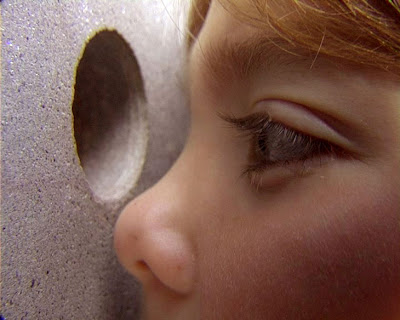
When Chodzko made the work Hole in 2007 he made a variation of a myth through the relationship between a museum and a woman who, daily, inscribes a description of her emotional state on a juge Led sign mounted on the side of the Mambo museum in Bologna. Then the sign has been removed, leaving holes from where it was fixed. These holes could be seen as a kind of ruins when it is the only physical that remains from the work except the video which is telling the story. This video firstly shows a child watching through one hole and several people putting fingers in it. The voice over is the woman talking about her fictional relationship with the museum. Thus, this work shows a myth set in the future where the only rests are these holes as traces of something that was imagined to occur in the future. Here again, the viewer is disoriented by the narration of a fictional story while the holes take part of reality.
In Chodzko's use of film, art as a pure idea to communicate the meaning of the work is no longer sufficient. It often start with an open question that cannot be really answered in its own terms without stepping out of the work. There is a clear absence of meaning which can only be resolved subjectively by imagination and the viewer's own experience. Truth and meaning are mixed with personal ideas and your point of view of human behaviour where the inexpressibe can only be reached with imagination and the experience is the only real thing we can have in control.
Chodzko took part of the Young British Artists generation but his art is almost impossible to categorise in one special domain when he is mixing several mediums all together constructing only a suggestion of ideas when the meaning of the work is in the hands of the audience whose position becomes one of a kind of code-breaker. The strangers that he is gathering for his work does not present tangible and precise results, using art as a proof more than a result. As an artist he does not create his own language but his own system of dealing with the world, offering a work constructed by variables surrounded by fiction and a generous imagination.
Following Borges' theory when he wrote the immanence of a revelation that does not occur is, perhaps, the aesthetic phenomenon, Chodzko's art could be seen in that perspective when the artwork a proof-principle for a much wider and sometimes mystical idea. It is an opened question on multiple interrogations where the artist appeals the viewer to use all his senses to understand the codes and find the meaning-key. It is clearly all comes down to individual experience.
dimanche 1 mai 2011

Back to classics


Following the development of Jacopo Robusti, one of the major painters of the Venetian tradition in Renaissance, the most outstanding work of his career came at the age of forty six, an impressive production of wall paintings and ceilings filling the Scuola Grande di San Rocco, a late foundation existing at the following of a decree of the Council of Ten in 1478 and associated to a church dedicated to Saint Roch. This precise Scuola was actually the first ever created in Italy which managed to group together a great variety of activities without any limits of a single organization. It was the one civic that cut across the social strata governed by the aristocracy of Venice and then, with members commissioning great artistic works, it became greatly concerned with displays of material magnificence.
The first intrusion of Tintoretto's artwork in the Scuola di Grande began on the 22nd of May 1564 when the brethren decided to decorate the Albergo, the smaller room of the building. A competition was then inaugurated between invited artists for the central oval panel; the subject was to be the Saint in Glory, Saint Roch. According to Giorgio Vasari, Tintoretto among the other painters called, deliberately undermined the competition and placed a fully finished painting at the chosen place when the scholars only asked for designs. Responding to them that this was his method of making designs and that he did not know how to proceed in other manners, Tintoretto emphasized his unscrupulous manner to obtain major commissions. However, this tactic revealed itself successful and he then obtained the Scuola members to commission him for the realisation of the long wall and the two smaller spaces on either side of the door on the opposite wall, finishing these works in an incredible short time of one year.

The Saint Roch in Glory within Tintoretto aimed his commission, appears as an exercise of the Venetian ceiling painting formula of the time, a sophisticated fusion of Venetian's chromaticism with the formal complexity of contemporary Mannerism. Indeed, he adopted a Titianesque palette of gold, cream, yellow and red with a composition which could remember the one of Titian's Assumption of the Virgin. In that way, the young painter clearly wanted, impressing his future commissioners, to show himself inserted in the central Italian manner of his competitors and contemporaries. Once he received the approbation of the brethren, Tintoretto could enter in the great realisation of his works for the Scuola, working under conditions of patronage that allowed the greatest possible freedom of interpretation.
This free hand resulted in the powerful Crucifixion, with this poignant work, Tintoretto entered gloriously in the huge series of the work for the Scuola. Yet, without forcing any of the gestures with an unnatural intensification, he built a tragic dramatic crowded scene. Even Ruskin found the task of describing the painting impossible. It presents, as no other crucifixion has even attempted to produce, a huge crowd of figures watching in quiet detachment Jesus Christ on his cross, a world that hardly even pauses to watch what he has just done. When usually an artist has to be selective, Tintoretto depicted here everything that this world contains and there is no meaningless figures or passages in the landscape that are not fully realized by the painter. And, as usual in the artist's manner, the figures seem to be all closely linked. The mourning group at the foot of the cross is, as the Christ, detached from the surrounding narrative episodes, taking a very poetic timeless quality.
Hence, with the Saint Roch in Glory and the Crucifixion, both the most important works he made in the Albergo room, Tintoretto clearly imposed his way of working in the place, a revolutionary painting without precedent at this time when he let the stages, full of mystery and drama, to act by themselves.
At this point of the year 1566, the scheme was eventually to fill the whole building with more than fifty works on walls and ceilings, the realisation took a pause of nearly eight years. The Scuola members then decided in May 1574 to renew the ceiling of the large upper room and, in view of the Saint's character, the iconography naturally felt on the themes of healing and miracle in both Old and New Testament. Having a planned iconographic theme in mind, Tintoretto proposed to paint the large central panel with the Brazen serpent, the archetype of healing miracle, finished in 1576 by the day of the Saint's feast as a gift to the Scuola.
The painting, the largest ceiling of the room, a restless but controlled turbulence14 shows the heaven power and human behaviour face to face. On the top of a stormy sky filled with the onrush of Almighty accompanied by a cohort of angels, Moses points to the serpent above his head. Below, on a fantastic rocky hill, lie down the Israelites. Tintoretto reached the depiction of a solitary leader in the Moses figure, against the sky, creating his theme into an earthly and celestial division, expressing a powerful struggle between damnation and salvation.
Thus, we can see here that, however the anachronistic relation the paintings could have with each other, Tintoretto tried to construct, following his works in the Albergo, a sense of continuity, interpreting the Christian scheme through a new intrusion of human reality in divine interventions.
The Brazen serpent was then joined by two other ceilings16, all the three finally in position by the year 1577. At this point, the Scuola, realising the greatness of their new artist, made Tintoretto its official artist promising to deliver three finished pictures each year on the Saint's feast day for the upper room. Consequently, Tintoretto entered in the second major project for the Scuola di San Rocco, working in this room until the year 1581.
With his precise iconography in mind, the artist then constructed a very concise division of the room in four groups related to the general imposed theme and however the Old and New testaments are mixed up, the artist constructed a clever narration of healing and miracles.
As an introduction to the room, the Temptation of Adam, is an unforgettable depiction of the subject when he pictured the same subject earlier as a simple pastoral picture, this ceiling painting is clearly deeper, full of guilt and mystery. When the body of Eve is going out in the darkness forest, Adam is timidly following her like a suspicious animal, the whole picture is a struggle between good and evil for both of the figures and an introduction to the theme of redemption.
Nevertheless the greatness of his ceiling paintings, Tintoretto only sensibly followed the Venetian solution of ceilings, for he was not by nature a decorator, thus this is not entirely by them that he is remembered.
Indeed, the creative energy that Tintoretto was called upon to use at this period of his career is more visible in the series of the wall paintings of the room which begins with the Nativity, a simultaneous robust and deeply poetic painting. The Virgin is lying uncomfortably in straws exposing the newborn child. Tintoretto's Christ child, like in the whole corpus of his representations of him, is not a traditional type but rather one of great energy and grace but, above all, a child of a great intelligence, cleverly aware of his future sacrifice for the humankind.
Below the holy group, at the first ground of the ruined architecture, the usual disorderliness of a farm statement is set up. All the features for an exceptional event are depicted for a solemnity that belongs to a unique occasion.
The next pair of wall paintings following the Nativity presents the Resurrection and the Ascension, both forming the central panel, a symmetry marking the centre of the wall. Here again, Tintoretto's spirituality strikes directly the eyes of the viewer when, in the Resurrection, the Christ rises up from the tomb in a burst of impressive light. The balanced Ascension is generally conceived in the same spirit but Tintoretto constructed a more original view of the figures. Indeed, the most surprising effect on the painting is the small scale of the figures compared to the landscape below. The painter thus had a double point of view where the simultaneous view of the ascendant Christ is contra balanced with the earth left behind.
Within these paintings, the importance of colour in Tintoretto's work is palpable. Black and grey seem to be the basis of his colour scheme moving away from his master and rival Titian use of colour. With advancing years in his career and the unique language of San Rocco’s artwork, he tended to construct a clear division between lyricism and drama by reserving the opulent Venetian bright colour nearly reaching monochrome. Hence, with these paintings, Tintoretto contributed to the general mood of the room, reaching a nocturnal and mysterious depiction of the religious themes. By both depicting the effect of a rising spirituality and the down sense of earth life, the upper hall constitutes an incredible example of Tintoretto's ability to depict the implications of the supernatural through the veil of the natural.

The large upper room completed, Tintoretto then worked two years in the church of San Rocco until the Scuola decided to commission him again for the realisation of the last room of the building, the lower hall. The iconography theme was decided to be concerned with the life of the Virgin, a series beginning with the Annunciation facing the entrance door and paintings running chronologically along the wall.
The annunciation was a great challenge for artists of the Renaissance. Like Botticelli did before, Tintoretto chose to construct a deep psychological barrier between the figures. This barrier should be seen as physically embodied by the massive wall of bricks that divides the picture vertically in two halves, separating the Virgin in the room from the outside world. Tintoretto's angel is crossing the wall, arriving in a great speed accompanied by several flying putti while the Virgin is sitting into a ruined room. This special movement, which had never been reached in any other annunciations before, is constructed by a combination of several insistent vertical and some horizontal lines to balance the whole composition. It resulted an incredible pictorial steadiness habited by a tornado-like conception of the graceful event, something really meaningful of the freedom of conception which was given to the artist compared to the one he painted for the church of San Rocco earlier. Indeed, the earlier appears to be a logical development form of the annunciation formula since Giotto's version while the later one has a different narration, a deep depiction of a unique event that had never been presented in that way before. Thus, compared to Titian's depiction of an exceptional happy moment, the painter of San Rocco had almost abandoned the Venetian formula only working from his own genius without following any schools.

The Flight into Egypt is the third painting of the room's wall, following chronologically the Annunciation and the Adoration of the Magi. This painting contains all the romantic statement linked with the subject when the holy travellers are seen at the precise escaping moment surrounded by a rich graceful invasive landscape in the background and foreground with a sweetness of sun lighting across the faraway hillsides. The original feature of this painting is embodied by the place of the group in the canvas, when Joseph leads the donkey and the group which, despite its dominant position among the wild environment, is not in the centre of the composition. The holy family is caught by Tintoretto at the precise climax moment of the scene, just before they passed out of the picture. Even Saint Joseph's foot is cut off by the frame, lost in a smoky foreground. We can see here again, the great engagement of Tintoretto's sense of poetic in religious subject as if the presence of the holy family in the composition is only a matter of chance.
The last picture of the room could be seen as one of the most significant as it is also the last work that Tintoretto made for the Scuola. It presents the subject of the Visitation closing his career in the building and concluding the series concerning the life of the Virgin. Surprisingly, the subject was depicted on a slightly small canvas but with an unusually rich surface. For this painting, Tintoretto used only the silhouettes to act as the central force and feature of the composition. To construct these figures of great strength, Tintoretto designed a ground line occupying the whole large base of the frame continuing itself through the dark foliage of a tree on the left. These features of both the tree and the dark foreground line had to be considered as the only environment of the composition as the background is a slight white and grey shadow, a suggestion of a faraway landscape. The special position of the figures is an invention of Tintoretto as the bodies are bowed, their heads inclined, building a slight movement of reverence and solemnity, a graceful position of the human body which would be copied by his contemporaries.
With this deeply poetic painting closing the work for the Scuola, the dark solemnity of the San Rocco style which began twenty years earlier with the Crucifixion, reached its climax in the Visitation of 1587.

The Tintoretto of San Rocco used few technical changes to underline new values in religious painting of the time. Indeed, when his lost of brushwork was just slightly suggestive in his earlier works, his non finito became much more significant in the San Rocco, coming to express a deep spiritual value. With this massive production, Tintoretto turned back from the Titian's precise manner to adopt a rather sketchy paint surface; a poetic chiaroscuro combined with muted tone and a dark ground preparation. In that sense, the Venetian painter adopted a material poverty securing a newly intense spirituality clearly abandoning the richness and impasto of the fashionable Venetian school of the time to which he himself contributed in early works.
He showed, in his wide corpus for San Rocco, the holy figures embracing the value of poverty seen as a symbol for inner spiritual life, mixing human behaviour and state of mind with divine interactions. His manner for the Scuola is clearly not one of a clear narration but rather one of a meaningful withdrawal, his compositions creating only suggestions of what happened. Within this way of working, Tintoretto created his own language of belief in painting; he developed his whole character through these works, expressing a truly inner truth in Art.
When the value of poverty is seen as the precondition for Christian redemption in the San Rocco paintings, Tintoretto's belief could be linked with contextual events, when the idea of poverty emerged in the wide sixteenth century with social and religious reforms became in the heart of Venetian culture.

mardi 29 mars 2011

Bauhaus' passion


Les passionnés d'une des plus innovatrice fondation d'art et design de l'histoire du vingtième siècle vont enfin pouvoir sortir du placard. Il aura fallut plus de quatre vingt ans pour que la victoire soit enfin rendue au légendaire Bauhaus et que Philippe Oswalt, directeur emblématique de la fondation Bauhaus Dessau entende remettre le magazine du groupe d'actualité donc la publication fût brusquement arrêtée en 1931, après la dissolution de l'institution sous le jour du fascisme Hitlérien.
Il était clairement temps de rendre un dernier hommage à l'école Allemande d'architecture et d'arts appliqués crée par l'architecte emblématique Walter Gropius en 1919 dans la ville de Weimar. Son influence sur les arts industriels et graphiques, sans précédent, le Bauhaus avait pour principe fondateur une fonction de l'art répondant aux besoins de la société ainsi qu'un pied d'égalité entre les beaux-arts et l'artisanat, une théologie communautaire révolutionnaire impliquant une différence quasi-impossible entre la pratique de l'art et la vie personnelle de ses composants, élèves et professeurs sans distinction.

De 1926 à 1931, Bauhaus a joué un rôle décisif dans l'émergence de nouveaux concepts en art, design et architecture. 

Bien plus que la fondation d'une école, le Bauhaus a construit toute une pensée à travers un style international reconnaissable parmi tant d'autres. Certains y virent le mouton noir déviant de l'art du vingtième siècle; d'autres, à juste titre, un nouveau point d'avancée considérable vers la modernité esthétique.
En 1925, l'école fût transférée à Dessau pour vivre dans un ensemble de bâtiments conçus par Walter Gropius assisté de professeurs et d'élèves de l'école, un édifice de verre et béton illustrant un fonctionnalisme rigoureux, dans un langage architectural proche du néo-plasticisme. Parmis les enseignants figurent de grandes figures emblématiques de l'art et l'architecture du vingtième siècle dont Hannes Meyer, Mies Van der Rohe, Joseph Albers, Paul Klee, Wassily Kandinsky, Oskar Schlemmer, Laslo Moholo-Nagy et même Kasimir Malévitch, figure emblématique créateur du Suprématisme, qui y fût un bref passage après avoir été rejeté par sa Russie natale.
Déplacé pour la troisième et dernière fois en 1933 dans la capitale Allemande sous la nouvelle direction de Mies Van der Rohe, avant que les nazis en ferme les portes six mois plus tard et que ses principaux composants migrent vers les Etats-Unis fondant à Chicago le New-Bauhaus à la source du style international.
La fondation entend là donner un nouveau souffle au mouvement brusquement censuré sous l'émergence du nazisme prônant une censure écrasante envers toute forme de modernisme n'entrant pas dans les critères du réalisme propagandiste classant ainsi le Bauhaus au cœur de l'art des aliénés , l'épuration de la représentation nazis prenant forme avec l'exposition des arts dégénérés (Entartete Kunst) organisée en 1937 à Munich.
L'hommage aux derniers travaux récents du Bauhaus va donc enfin être rendu et le premier numéro du magazine ré-édité sera consacré à l'artiste Kurt Kranz (1910 – 1997) photographe et cinéaste Allemand.

mardi 15 mars 2011

Folie pré-supposée


Au premier regard face à une sculpture de Franz Xavier Messerschimdt, le spectateur peut immédiatement penser que son travail se place au coeur des derniers siècles contemporains. Un autre visage de l'histoire de la sculpture se dévoile lorsque le cartel placé sur le socle de chaque buste indique "sculpteur viennois du XVIIeme siècle". Loin d'être une erreur venant du comissaire de l'exposition, bien au contraire, au plus grand plaisir de chacun, les poses hiératiques royales d'un réalisme parfois trop conservateurs ne sont pas les seules à reigner dans la somptueuse et cruelle Vienne impériale.
Bien que Messerschmidt excéla à modeler l'impératrice Marie-Thérèse, son incroyable créativité reste enfermée derrière ses ciseaux. Pourvu d'un sens de l'observation hors normes et d'une faculté à rendre parfaitement les moindres détails d'une physionomie complexe, c'est cette précision sans pareille qui lui vaudra censure. En effet, en ce 30 ocobre 1774 la comission de l'Académie Royale de Vienne décida que ses apparents troubles mentaux liés à une imagination excessivement morbide lui vaudront sa place d'enseignement qu'il occupait depuis plus de cinq années. Il en fallut peu pour que le génie de Messerschmidt sorte enfin de sa cage, avec en poche une maigre rente pourvu à sa survie sans causer d'ennuis à la prestigieuse Académie, il se lança alors au coeur d'une mission artistique individuelle.
Dépourvu de comission, Messerschmidt attaque ainsi une production effrénée d'expressions faciales, pour la plupart sculptées dans le bronze, réalisées à l'aide d'un miroir. Peu importe si ce fût le résultat d'un hypernarcissisme poussé, une obsession pour la physionomie, une folie maladive, une paranoïa exagérée ou une certaine aliénation, l'artiste emblématique viennois représente une figure extravertie se dressant contre les conventions ultra-conservatrices et codifiées de son temps. C'est ainsi que sont nées les incroyables têtes d'expressions qui lui valent aujourd'hui une postérité largement méritée.
Sans même complètement savoir si elles furent le résultat d'une recherche de profondeur psychologique, l'inépuisable quantité de description faciales qui furent crées sous sa main se trouvent alors au coeur d'une mélodie de l'âme sans précédent dans l'histoire de l'art. Rongé par la folie ou non, perclu par la douleur ou non, Messerschmidt a construit une oeuvre d'une originalité dont la rencontre fait instantanément prendre toute la mesure au spectateur qui la confronte de la profondeur et la grande diversité du charactère humain, chapeau bas.

dimanche 13 mars 2011

The physical impossibility of Death in the mind of someone living


In the 1990s the term of conceptual art has become increasingly linked with the idea of the far out or crazy where outrage and scandal was being a strong artistic expression and a certain way to get the attention of the media. This new phenomena worked perfectly with Damien Hirst the most provocative known of the 1990s in the group Young British Artists, who had the habit to cutting up animals displaying them in formaldehyde, an ingenious conflation of the readymade with the memento mori.

“Art’s about life and it can’t really be anything else. There isn’t anything else.”

In his whole career, Damien Hirst, born in 1965, is almost always dealing with life and death and he came to it in a way after the works of Francis Bacon and Andy Warhol, his two major heroes. He approached his first works prominently inspired by their works, Bacon dealing with man as flesh and meat, Warhol dealing with logo like of sharp punchy elements. Hirst manages to combine the two together and constructs a whole philosophy around the dichotomy of life and death face to face.
Even in his very early years, the artist opened his own career with the confrontation of life and death with the photograph With Dead Head realised in 1981 while Hirst, only sixteen at this time, poses with a severed head at the morgue in Leeds where he was studying microbiology. In fact, it was the study of this special branch of biology dealing with function and structure of microscopic organisms that brought him to the science and study of diseases and death. This photograph is one of the most iconic images of the artist ever taken, it was surely rejected by a wide range of people and critics, and nevertheless it was the best way to a confrontation between life and death. This photograph reveals the future fascination of the artist for corpses and his idea of how they can be both visually horrific and beautiful at the same time.

With Forms without Life Hirst arranges a selection of ornate shells purchased in Thailand inside a cabinet creating an installation which resembles a museum display case and presents a reference to the nineteenth-century tradition of collecting natural specimens. Thus, in this work Hirst alludes the certain rejection by conceptual artists of his generation of museum’s system by evocating the idea of death in a totally different way. Indeed, the work is not a simply allusion to the collecting system of museum but rather the idea that by collecting these items, by removing them from their natural habitat simultaneously provokes their death. Such an approach is comparable with the concept of killing them to preserve them.

One of the first time he developed the idea of disease went in 1992 with his Pharmacy, a room-sized installation representing a pharmacy initially shown at the Cohen gallery in New York. It contains four glass apothecary bottles filled with coloured liquids representing the four elements: earth, air, fire and water, which seems to remain ancient practices of treating the body. The counter fronts three desks, covered with an array of office equipment and stationery, and three chairs.
As Hirst himself said “I've always seen medicine cabinets as bodies”, all those pharmacy packages which are for the living used as a bareer toward death, represent in a way the whole body (as some are classified on the shelves according to their function on the body) facing and unifying itself at the same time with death. Once again, Pharmacy is connecting the idea of the museum or gallery space with the laboratory or hospital both domains providing a belief system which is sometime illusory. This work could be seen as a representation of the multiple range of philosophy where, like medicine, art bring us to think that life or death are eternally doomed to failure.
Five years later, Hisrt created a restaurant in Nothing Hill, London in association with Matthew Freud, keeping this idea of a pharmacy-like place, he called it Pharmacy. The windows displayed pillboxes and packets of haemorrhoid cream, the bar stools were shaped like aspirins; there was also a molecular structure of Hirst's DNA. The restaurant closed in September 2003 as the Royal Pharmaceutical society of Great Britain claimed that the place could confused people looking for a real pharmacy and it was auctionned to Sotheby's.

Obviously, the career of the artist was closely linked with the collector Charles Saatchi who offered him in 1991 to fund whatever artwork he wanted to make. The result was showcased in 1992 in the first Young British artists exhibition at the Saatchi Gallery in North London . There hirst exposed The physical impossibility of Death in the mind of someone living, a shark in formal dehyde in a vitrine which became the iconic work of the artist, a symbol of british art worldwide and a nomination for that year's Turner Prize.
The work took part of his "natural history" pieces featuring dead animals floating in vitrines full of formaldehyde. As the shark looks alive but is dead preserved completelly intact in formaldehyde (which is its principal function), Hirst completelly entered in his increasing reference to life and death. Both are violently exposed to the audience facing them, as the glass tank is both a window and barrier, both seducing and horrifying the viewer. Best known for this piece and mother and child divided (1993), his work recast here again fundamental questions concerning the meaning of life and the fragility of biological existence.
Mother and child divided could be placed in one of his most controversial work comprising four glass-walled tanks containing the two halves of a cow and a calf bisected and preserved again in formaldehyde with sufficient space between each pair that a visitor can walk between them and view the inside of the animals. This work was created for the Venice Biennale of 1993 and was the focal point and winner of 1995 Turner Prize.
The aesthetic of Hirst's tank became his most famous signature, he commented himself that the vitrines: " first came from a fear of everything in life being so fragile’ and wanting ‘to make a sculpture where the fragility was encased. Where it exists in its own space. The sculpture is spatially contained."
Central to these work is the preservation in the face of death, which is approached ironically when whatever we do to protect bodies they will desintegrate and die. And here, instead of representing the sanctified unity of the mother and child, he celebrates them only separated from one another.

Hirst continued to use his animals in tanks as a metaphor to religion with Away from the flock, created in 1994, another natural history works, featuring a sheep floating in formaldehyde. Again, the lamb looks alive but is dead, but Hirst enters into a new level of thinking when it references the religious theme of the lamb of God. This strong christian connotation joins the theme of life and death and the idea of believing. When before he was controversing the way that people believe in medicine and not art, he does here the same with religion when it is also a way to barrier and rule devoting life and death. Whilst it was exposed at the Serpentine gallery in London a visitor poured black into the tank and retitled the work Black sheep.
Religion is also explored further away in the large tryptich work Trinity - Pharmacology, Physiology, Pathology in which Hirst joined together medicine and religion as one can replace the other as a tool barrier on death and a way to prolongating the faith in life.

Then, entering in the years 2000, Hirst add a human-death presence in his concept with the work Hymn, a polychrome bronze sculpture revealing the anatomical musculature and internal organs of the human body on a monumental scale. Something which atteined its climax four years later with Virgin mother, a huge sculpture representing the internal and external anatomy of a pregnant woman. As he made the same with animals here visitors can see both external and inside of the women figure and the foetus she is holding in her womb. No clues are given to her living status as we may think that she is dead. With this work, closing in a way the series of bisected features, Hirst claims that we can learn more about living bodies by studying dead bodies something from what he was accused of plagiarism by an educationnal brand of toys.
Here is one of the climax that the artist atteined throught the development of his works and philosophy from the 1990s to the present day.

The british artist is also renowed for his paintings including his Butterfly paintings, as for instance the large diptych Monument to the living and dead (2006) using butterflies as a metaphor for mortality and traditionnal symbols of the soul. That is how in 1991, he filled a London gallery with hundreds of live tropical butterflies, some of them growing from chrysalises on monochrome canvasses hung on the wall.

In 2007 came his most provocative work calle for the love of god, a life-sized platinum cast of a human skull covered entirely by set diamonds, something without any precedent in art history.
The work is clearly a traditional memento mori, where an image or object serves to remind us of our mortality, as if he unveiled the skull of his severed head of 1981 and covered it by diamonds. The anecdote about the idea which came into his head is a response to his mother who told him "for the love of god, what are you gonna do next time?". It resulted the priciest work of a living artist.
“I remember thinking it would be great to do a diamond one — but just prohibitively expensive,” he recalls. “Then I started to think — maybe that’s why it is a good thing to do. Death is such a heavy subject, it would be good to make something that laughed in the face of it.”
Here Hirst reach the idea of death in a more ironical way, compared to the sadness of vanitas scene, the diamond skull is glory itself, as the death's victory over life.
Obviously, as there is no work of art made by Damien Hirst which is not directly or undirectly related to Death and Life, he developed a whole phylosophy on the subject throught is entire career and continues it on the present day. When his materiality and the prices of his pieces could be in opposition to certain conceptual ideas, his approach to the realisation of a work of art is clearly conceptual.
"Art goes in your head, it comes from everywhere. It's our response to your surroundings" he said, an art which gives priority to the idea, delivering a powerfull message and challenging the tradition of the work of art.